Showing posts with label Electricity. Show all posts
Showing posts with label Electricity. Show all posts
Wednesday, March 19, 2014


Saturday, July 24, 2010
Powered by Lithium: The Vauxhall Ampera TNR.v, TSLA, CZX.v, RM.v, LI.v, WLC.v, LIT.v, CLQ.v, AVL.to, NSANY, BYDDY, GM, BMW, DAI, FCX, RTP, BHP, HEV,

After Royal endorsement Ampera is making its PR rounds in UK. Very interesting is the spin in the FT article - this EV is "almost" like a "normal car".
 Image via Wikipedia
"US Senate panel backs more electric cars, solar
Wed Jul 21, 2010
* Bill wants half of U.S. vehicles electrified by 2030
This is what we need to address dire consequences of Peak Oil. There is still time and technology available to us to electrify our transportation system. Electric cars are coming on the roads and Asian conglomerates are busy building Supply Chain for Electric Cars starting with lithium deposits. Will US Corp. finally awaken to this geopolitical problem?"
FT:
FT:
The Vauxhall Ampera
By John Griffiths
Published: July 24 2010 00:28
I have driven the future around the back lanes of Buckinghamshire, and it works – mostly. The Vauxhall Ampera, known to the wider world as General Motors’ Chevrolet Volt, has been proclaimed by GM as the holy grail of low fuel consumption and CO2 emissions.
Its technology overcomes both the daunting drawbacks of purely battery-powered electric cars and the relatively limited contributions conventional “hybrid” cars such as Honda’s Insight and Toyota’s Prius make to reduced fossil fuel consumption and CO2 emissions. This is despite their “green” image and the benefits they receive such as exemption from London’s £8 per day congestion charge. In the real world, both cars do well to achieve a (still laudable) 50-60 miles on a gallon of petrol and can go only very short distances on CO2-free battery power alone, mostly at crawling speed in stop-start urban traffic. On the open road, even though their modestly sized electric motor and battery pack drive in parallel with a petrol engine, the latter has to work almost as hard as a conventional car’s to maintain a satisfactory rate of progress.
So far, then, it is not much different from other battery-powered cars which, like the Ampera, can be plugged in at the office during the day in order to increase commuting distances.
The crucial difference becomes apparent when long distances are involved. I found when testing the £92,000 Tesla battery-powered sports car that the claimed 200-mile range fell closer to 100 when its power was used to the full, with 16 hours required for a full recharge using a household socket. BMW’s prototype battery-powered Mini had only slightly greater range (at the cost of losing the rear seats to make way for the battery pack).
Both will thus go considerably further than the Ampera without recharging. The crucial difference, however, is that when the Ampera’s batteries are in danger of running out of puff, it simply activates its own on-board petrol generator simultaneously to power the electric drive unit and to recharge the batteries. GM engineers insist this provides 350 miles of range using full performance before refuelling for generator or battery pack is required. But the Ampera’s advantage grows further in that even a three-hour dalliance with a conventional household socket is enough to kick the batteries back to full life and another 350 miles can be put under the wheels.
Unlike conventional hybrids, the Ampera’s wheels are driven exclusively by electricity. Its startlingly brisk performance is down to the 150 horsepower-equivalent electric drive motor, delivering its full, thumping 370 newton metres of torque from standstill. According to a GM spokesman, the per-mile cost of the Ampera using standard-rate electricity should be only about one-fifth that of a similar-sized conventional car.
Little of the above matters, however, if the Ampera turns out to be rotten to drive or, like the Tesla, costs several arms and legs more than its rivals. But GM has little to worry about on the drive experience.
The Ampera looks appealingly dramatic and executive sector-ish from the front, but is based on the same engineering platform as the Vauxhall Astra family car range built at Merseyside’s Ellesmere Port. It even drives like the comfortable but agile Astra, except on three counts. One is that the division of electric motor and battery pack between front and rear gives it almost 50-50 weight distribution, and thus even greater agility. The second is the liveliness of the acceleration thanks to maximum torque being available at any time. The third is the weird absence of mechanical noise when using battery power alone, and the tiny margin by which noise is increased when the petrol generator kicks in.
But the overwhelming sense in which the Ampera works is its lack of demands upon driver and passengers. Its interior space and seating are no different from conventional, similar-sized cars. The dashboard looks mildly futuristic and has some instruments, such as battery status and energy drawdown, which take a few seconds to learn. But otherwise it’s simply hop in, turn the key, engage the automatic gearshift and go. Refuelling the generator is straightforward via the garage petrol pump and the electric plug-in is likely to be problematical only to those who have to park in the street.
Where it only “mostly” works lies in pricing. Vauxhall, which is pitching hard to be allowed by GM to build Europe’s Amperas at Ellesmere Port, is projecting a UK launch price of about £30,000 if hopes of government “green” cash incentives of up to £5,000 per car go unrealised, as seems likely. That puts it well into BMW 3 Series territory and some £7,000 more than the most expensive Astra.
But factor in exemption from London’s congestion charge, zero road tax and the 300-plus gallons of fuel a year Vauxhall reckons can be saved compared with a 40mpg car by a driver covering 15,000 miles a year, and the gap looks considerably less formidable. The smug smirk of a green CO2 “hero” comes for free."
By John Griffiths
Published: July 24 2010 00:28
I have driven the future around the back lanes of Buckinghamshire, and it works – mostly. The Vauxhall Ampera, known to the wider world as General Motors’ Chevrolet Volt, has been proclaimed by GM as the holy grail of low fuel consumption and CO2 emissions.
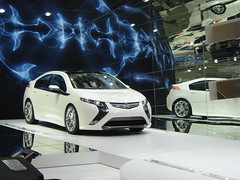 Image by harry_nl via Flickr
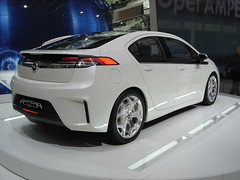 Image by harry_nl via Flickr
Its technology overcomes both the daunting drawbacks of purely battery-powered electric cars and the relatively limited contributions conventional “hybrid” cars such as Honda’s Insight and Toyota’s Prius make to reduced fossil fuel consumption and CO2 emissions. This is despite their “green” image and the benefits they receive such as exemption from London’s £8 per day congestion charge. In the real world, both cars do well to achieve a (still laudable) 50-60 miles on a gallon of petrol and can go only very short distances on CO2-free battery power alone, mostly at crawling speed in stop-start urban traffic. On the open road, even though their modestly sized electric motor and battery pack drive in parallel with a petrol engine, the latter has to work almost as hard as a conventional car’s to maintain a satisfactory rate of progress.
 Image via Wikipedia
So far, then, it is not much different from other battery-powered cars which, like the Ampera, can be plugged in at the office during the day in order to increase commuting distances.
The crucial difference becomes apparent when long distances are involved. I found when testing the £92,000 Tesla battery-powered sports car that the claimed 200-mile range fell closer to 100 when its power was used to the full, with 16 hours required for a full recharge using a household socket. BMW’s prototype battery-powered Mini had only slightly greater range (at the cost of losing the rear seats to make way for the battery pack).
Both will thus go considerably further than the Ampera without recharging. The crucial difference, however, is that when the Ampera’s batteries are in danger of running out of puff, it simply activates its own on-board petrol generator simultaneously to power the electric drive unit and to recharge the batteries. GM engineers insist this provides 350 miles of range using full performance before refuelling for generator or battery pack is required. But the Ampera’s advantage grows further in that even a three-hour dalliance with a conventional household socket is enough to kick the batteries back to full life and another 350 miles can be put under the wheels.
Unlike conventional hybrids, the Ampera’s wheels are driven exclusively by electricity. Its startlingly brisk performance is down to the 150 horsepower-equivalent electric drive motor, delivering its full, thumping 370 newton metres of torque from standstill. According to a GM spokesman, the per-mile cost of the Ampera using standard-rate electricity should be only about one-fifth that of a similar-sized conventional car.
Little of the above matters, however, if the Ampera turns out to be rotten to drive or, like the Tesla, costs several arms and legs more than its rivals. But GM has little to worry about on the drive experience.
The Ampera looks appealingly dramatic and executive sector-ish from the front, but is based on the same engineering platform as the Vauxhall Astra family car range built at Merseyside’s Ellesmere Port. It even drives like the comfortable but agile Astra, except on three counts. One is that the division of electric motor and battery pack between front and rear gives it almost 50-50 weight distribution, and thus even greater agility. The second is the liveliness of the acceleration thanks to maximum torque being available at any time. The third is the weird absence of mechanical noise when using battery power alone, and the tiny margin by which noise is increased when the petrol generator kicks in.
But the overwhelming sense in which the Ampera works is its lack of demands upon driver and passengers. Its interior space and seating are no different from conventional, similar-sized cars. The dashboard looks mildly futuristic and has some instruments, such as battery status and energy drawdown, which take a few seconds to learn. But otherwise it’s simply hop in, turn the key, engage the automatic gearshift and go. Refuelling the generator is straightforward via the garage petrol pump and the electric plug-in is likely to be problematical only to those who have to park in the street.
Where it only “mostly” works lies in pricing. Vauxhall, which is pitching hard to be allowed by GM to build Europe’s Amperas at Ellesmere Port, is projecting a UK launch price of about £30,000 if hopes of government “green” cash incentives of up to £5,000 per car go unrealised, as seems likely. That puts it well into BMW 3 Series territory and some £7,000 more than the most expensive Astra.
But factor in exemption from London’s congestion charge, zero road tax and the 300-plus gallons of fuel a year Vauxhall reckons can be saved compared with a 40mpg car by a driver covering 15,000 miles a year, and the gap looks considerably less formidable. The smug smirk of a green CO2 “hero” comes for free."

Friday, July 23, 2010
Powered by Lithium: Brammo Empulse: The New 100mph King of Consumer Electric Motorcycles TNR.v, TSLA, CZX.v, RM.v, LIT.v, LI.v, LAT.v, WLC.v, CLQ.v

Do you remember this mobile communication devise above? Price tag was more than 10000 USD and it was 20 short years ago. This is the power of progress and technology, we can not make new Oil, but we can use available technology and store electricity now with enough power to keep the world moving even when the oil will be gone. It is simple, it is groundbreaking, it is here.

Electric Motorcycles are not toys any more - this message is the most important for our investment opportunity of the decade. Once disruptive technology is out of the Oil addiction cage progress will be made very fast with increased power capacity and durability of Lithium ion batteries and lightweight superpower electric motors.
 Image via Wikipedia
"We were running on Oil for the one hundred years, now we have means to store electricity and run on it. It is simple, but groundbreaking statement - this disruptive technology will change our world and provide investment opportunity of the generation."
Popsci.com:
"Brammo Empulse: The New 100mph King of Consumer Electric Motorcycles, Sold At Best Buy
By Wes Siler
Electric motorcycles no longer need be thought of as slow and boring. When the Brammo Empulse, successor to last year's Enertia, goes on sale early next year it’ll be capable of reaching speeds in excess of 100 mph with an average range of up to 100 miles.
That bests the Enertia's 60 mph ceiling over a range of 45 miles. The key to the performance boost is a new liquid-cooled motor a little bit similar to the one used on the 2010 MotoCzysz E1pc, but unlike that futuristic, one-off race bike, this one will be available at Best Buy and will be surprisingly affordable. Prices will run from $9,995 to $13,995, but a raft of electric vehicle tax breaks could bring that more expensive figure as low as $7,000 depending on which state you live in and which breaks you qualify for.
The Empulse puts out 55 HP and 59 Lb-Ft of torque while weighing just 390 Lbs. That should give it performance on par with a 650cc Suzuki Internal Combustion Engine motorcycle, which is to say it’ll accelerate faster than most sports cars.
Three models will be offered, with battery pack capacities the only thing separating them:
•Brammo Empulse 6.0: 6kwh battery capacity, 60-mile average range, $9,995
•Brammo Empulse 8.0: 8kWh, 80-mile average range, $11,995
•Brammo Empulse 10.0: 10kWh, 100-mile average range, $13,995
Those ranges have been calculated using an equal mix of city and highway riding. Stick to slower surface streets and the 10.0’s range will increase to 130+ miles, while long periods of high-speed cruising could see it shrink to 60-70 miles.
The big technology breakthrough here is the price-to-energy density ratio of the battery packs. While Brammo doesn’t plan to say much about the proprietary technology before the Empulse goes on sale early next year, expect some sort of Lithium Polymer chemistry. To put that ratio into perspective, Brammo’s biggest competitor, Zero Motorycles, offers bikes with a 4kWh capacity for $9,995.
Unfortunately, that new technology isn’t going to do much for recharge times. Using a standard 110v outlet, expect the 10.0 to take between six and eight hours for a full charge. Battery charge times aren’t linear though, a quick top-up of a half or three-quarters full battery should only take a couple hours.
Like all other electric motorcycles, the Empulse will be virtually silent and there’s no tailpipe to spew harmful emissions.
Leaning In: A pre-production model seen here being driven by Brammo designer Brian Wismann Brammo
The bike you see in these photos is actually a pre-production unit fitted with a lower-spec motor. The guy riding it is Brammo’s designer Brian Wismann who says, “even with 40 HP, the bike has no problem reaching 100 mph.”
“It’s not the fastest thing on the road,” continues Wismann, “but it is really fun to ride and is plenty fast to get yourself into trouble.”
The Empulse isn’t just going to be a straight-line performer though. Its stiff aluminum frame and top-drawer suspension mean its designed to go around corners too. Brammo actually plans to unveil the Empulse to the public by racing it against the MotoCzysz at California’s Laguna Seca Raceway later this month. It might not win, but it will be the only race bike there you’ll see in a Best Buy showroom in six to seven months time."

Thursday, July 22, 2010
Electric Cars, Batteries and Lithium: Next Big Thing in action TNR.v, TSLA, CZX.v, LI.v, RM.v, LIT.v, LAT.v, WLC.v, CLQ.v, SQM, FMC, GM, F, NSANY, HEV

Here comes the Royal endorsement of the Green Mobility. Our Next Big Thing is officially in action now and most lithium junior miners are rising today with the markets. We are preaching here already for another about Green Mobility and these days this thing is taking off in mass media finally.
 Image via Wikipedia
TheGreenCarWebsite:
Prince Michael of Kent, a keen car enthusiast took quickly to the car after he was shown how the it operates and performs. According to its maker, Vauxhall, the Prince was impressed by the cars strong performance with its electric range of 350 miles and 0-62mph time of 9 seconds.
After a quick spin in the new model, the Prince expressed how pleased he was with the ride and was keen to discover if the car would also be available in black.
Set to hit the roads in 2012, the Ampera is capable on running on electric power alone, but has a back-up combustion engine to replenish the batteries once they are depleted. This allows the model to travel further and should help buyers overcome the dreaded ‘range anxiety’."
After a quick spin in the new model, the Prince expressed how pleased he was with the ride and was keen to discover if the car would also be available in black.
 Image via Wikipedia
Set to hit the roads in 2012, the Ampera is capable on running on electric power alone, but has a back-up combustion engine to replenish the batteries once they are depleted. This allows the model to travel further and should help buyers overcome the dreaded ‘range anxiety’."

Subscribe to:
Posts (Atom)