Showing posts with label Exchange-traded fund. Show all posts

Tuesday, April 08, 2014

Peter Schiff: Weak Jobs Report, Weather, US Dollar And Gold MUX TNR.v GLD GDX


  US Dollar has dived again below 80.00 level and closed today at 79.76. A lot of hot plays in NASDAQ in 2013 are in the official bear market now sliding more than 20% from the top. Gold has regained the $1,300 level and closed today at $1,308 with the intraday high of $1,315. Levitation in the markets will be very difficult to create now as the housing market is in a very real slowdown already vs a lot of estimated growth rates totally disconnected from economic reality.
  "Sale In May And Go Away" has already started in April,  while heads on Bubble TV are screaming that it is the buying opportunity and read the Flash Boys by Michael Lewis to understand how you have been "front run" in every markets for years by The Wall Street Insiders.


WEB Bubble 2.0 Bursting, NASDAQ Meltdown And Gold TNR.v ILC.v MUX GDX GLD QQQ DIA SPY

  "WEB Bubble 2.0 is bursting and SOCL - Social Media ETF on the chart above is the very good representation of what is happening with the hot plays of 2013. SOCL ETF is just a notch away from the official bear market with 19.4% decline from its top so far. As we have noted before, the hot IPO market is another sign of the important top in the equity markets, when insiders are selling out at the valuations totally disconnected from the real underlining economic situation." 

Russia should switch to ruble payments with all trading partners - head of VTB Bank


Gold Surges As US Dollar Exit Begins: Russia Largest Bank Halts Foreign Currency Loans MUX TNR.v GLD GDX


 "CS. It did not take long for Putin to start its retaliation against the sanctions and excuse was presented by JP Morgan's block of some payments on the grounds that Bank Rossii was involved in transaction. Bank Rossii was on the list of sanctions and even its issued international credit cards were declined after that. Mr Putin said that he will open his personal account in that bank and now it became really personal. We are not judging who is right in all this mess created by CIA vs KGB 2014 War Games, but ultimately aimed to push China from its path of Dangerously Fast Rising Into Power by all means possible including the last asset of the Falling Empire - Military Industrial Complex. We are just observing the outcome. More."

Enhanced by Zemanta

Saturday, January 18, 2014

Eric Sprott: One More Sign of Manipulation in the Gold Market GLD, TNR.v, MUX, GDX


  Eric Sprott presents more evidence on the complex web created by Central Banks in order to manipulate Gold market. Latest news from German investigation of the Gold manipulation has already claimed the first victim with Deutsche Bank quitting the Gold Fix. Gold has closed above very important level of $1250 last week and now $1270 is within the reach which will ignite the short covering rally and confirm the Double Bottom Reversal at $1180 in 2013.

China Expands Gold Reserves to 2,710 Tons - Third Largest In The World GLD, TNR,v, MUX, GDX

 "Now we have the confirmation from China IMF reporting to the previous report from Bloomberg. China is very serious in accumulation Gold and latest reports from Germany about the Gold price manipulation are coming now with the record leverage at COMEX with 112 owners per each ounce of Gold!"

ZeroHedge: Precious Metals Manipulation Worse Than Libor Scandal, German Regulator Says GLD, TNR.v, MUX, GDX

"ZeroHedge reports on latest news from Bloomberg about Gold manipulation investigation in Europe. No surprises for us here - it is worse than Libor scandal. Will this news propel Gold above $1270 now to confirm the Double Bottom Reversal in 2013?"

Arthur Cutten: COMEX Gold Potential Claims Per Deliverable Ounce Rises to Historical High 112 to 1 GLD, TNR.v, MUX, GDX


 "After issuing his Buy Signal on Gold, Arthur reports the new historical all-time-high leverage at COMEX with 112 potential owners for each one ounce of Gold!"


SprottGlobal:

One More Sign of Manipulation in the Gold Market

By Eric Sprott
Introduction
As we very well know, 2013 was a difficult but also puzzling year for precious metals investors. The price of gold, silver and their related equities declined by a significant amount while demand for physical bullion from emerging markets and their Central Banks was exceptionally strong.
A common argument that has been made to explain the precipitous decline of the price of precious metals in 2013 is of investors’ disenchantment with precious metals, which had been piling up in exchange traded products as a way for investors to gain exposure to the metals. Proponents of this theory point to the large declines in the total holdings of those ETFs as evidence of investors fleeing the precious metal trade. As shown in Figure 1, the price of both gold and silver suffered very significant declines throughout 2013. Therefore, if this explanation is correct, one would expect the total ETF holdings of both metals to be lower as well.
However, this is not the case. As shown in Figure 2 gold ETFs suffered large redemptions whereas silver ETFs saw their holdings remain more or less constant throughout the year, and this without any observable change in trading patterns in the two largest ETFs; GLD and SLV (Figure 3 shows the ratio of the trading values in the ETFs over time). If redemptions are a symptom of investors’ disenchantment with precious metals as an investment, shouldn’t silver have suffered the same fate as gold? Indeed it should have, but we think the reason silver ETFs were not raided like gold was that Central Banks do not have a silver supply problem, they have a gold problem. As we have argued before, the raiding of gold ETFs is bullish for gold because it reflects an imbalance in the physical market.1
Figure 1: Gold and Silver prices declined significantly in 2013
maag-01-2014-1.gif
 Source: Bloomberg
Figure 2: ETF Holdings - Troy oz (millions)
maag-01-2014-2.gif
Source: Bloomberg, tickers ETSITOTL & ETFGTOTL
In this article, we further argue that the April raid on gold and gold ETFs almost backfired by creating a tsunami of buying in India and increased demand to unsustainable levels. In May 2013 alone, Indians imported 162 tonnes2 of gold in a market where monthly global mine production is about 182 tonnes. A continuation of this trend, coupled with strong buying from other Emerging Markets and their Central Banks, would have been overwhelming. But, the response was swift. We suspect that, at the behest of Western Central Banks, the Reserve Bank of India reacted by enacting, in incremental steps, restrictive measures to prevent gold imports (See Figure 4 for a timeline of the major changes made by the Indian Government).3
Figure 3: Traded Value - Ratio of SLV to GLD
maag-01-2014-3.gif
Source: Bloomberg. Traded Value is calculated by taking the total trading volume for a quarter and multiplying it by the average price over that quarter. A ratio of 1 indicates that SLV traded as much, in $ terms, as GLD.
Figure 4: Efforts to Curb Indian Gold Imports
maag-01-2014-4.gif
Source: Bloomberg, Economic Times 

Supply and Demand Imbalances: The Indian Effect 
We have already discussed at length the supply and demand imbalance in an Open Letter to the World Gold Council, asking them to revise their methodology because it grossly understates the amount of demand coming from emerging markets.4 Our gold supply and demand table (Table 1) reflects the latest available data (2013 Q3 in most cases). World mine production, excluding Chinese and Russian production still stands at about 2,100 tonnes a year. Chinese net imports most likely exceeded 1,700 tonnes for 2013 (81% of world mine production) and demand from the rest of the world is rather stable.5
The overall picture has not changed much since our last article, with the exception of Indian imports. As of the second quarter of 2013, India had cumulative net gold imports of 551 tonnes, which annualizes to 1,102 tonnes.6 However, Q3 data shows net imports of only 31 tonnes (for a total of 582 tonnes YTD), which annualizes to 776 tonnes.
This incredible loss of momentum for “official” gold imports was the result of concerted actions by the Reserve Bank of India and the Indian Government. While the “official” justification for those restrictions is the large Indian current account deficit, this argument makes little sense. According to government officials, Indian’s taste for gold and the corresponding imports worsens the country’s trade balance, worsens its current account deficit and puts downward pressure on their currency, the Rupee.
But, without going into too many details, the classification of gold as a “good” in the trade balance is at best misleading. Since gold is more of an investment vehicle and is not “consumable” per se, it should instead be accounted for in the capital account of the balance of payments instead of the current account. Indeed, Switzerland, which is a large net importer of gold, reports its trade balance “without precious metals, precious stones and gems as well as art and antiques” to reflect fact that those are “investments” rather than consumption goods.9 In this case, why should India be any different and report their trade data excluding gold? To us, all the fuss about gold imports by the Indian Government is a red herring.
So, without the intervention in the Indian gold market, the shortage of gold would have wreaked havoc in the market, a situation that Western Central Banks could not tolerate.
 Table 1: World Gold Supply and Demand 2013, in Tonnes
maag-01-2014-5.gif
Sources: GFMS data comes from the WGC’s “Gold Demand Trends” publications for 2013 Q1, Q2 & Q3. Chinese mine supply comes from the China Gold Association and is up to October 2013, the annualized number is a Sprott estimate.8 Russian mine supply comes from the Union of Gold Producers and is up to 2013 Q3. Chinese data is taken from the Hong Kong Census and Statistics Department and covers the period Jan.-Nov. 2013 and is annualized to account for the missing month. Changes in Central Bank gold reserves are taken from the IMF’s International Financial Statistics, as published on the World Gold Council’s website for 2013 Q1, Q2 & Q3 and include all international organizations as well as all central banks. Net imports for Thailand, Turkey and India come from the UN Comtrade database and include gold coins, scrap, powder, jewellery and other items made of gold. The data is for 2013 Q1, Q2 & Q3. ETFs data comes from GFMS as well.

Conclusion and Outlook for 2014
As demonstrated in our Open Letter to the World Gold Council, there was a large supply-demand imbalance in 2013. The evidence presented here suggests that the decline in the price of gold in mid-2013 and the subsequent raid of gold ETFs (but not silver ETFs) was engineered by Western Central Banks to help solve their physical gold supply problem. However, the resulting increase in Indian gold demand exacerbated the problem. The solution was to restrict Indians from importing gold by all means possible in order to help the Western Central Banks regain control of the gold market.
However, the rate of drain in gold ETFs cannot continue forever; at the current pace of 930 tonnes/year, there are less than two years of gold left in ETFs. Moreover, Indians have proved highly creative at finding ways around import restrictions.10 Smuggling is on the rise and will most likely increase as smugglers become more sophisticated. Overall, we believe that interest in physical gold from emerging markets will remain a driving force.
Besides, mine production is unlikely to grow, as reflected by the significant decrease in capital expenditures expected for the major gold producers (Figure 5).
Accordingly, we believe that the manipulation of gold prices by central banks, as demonstrated by the above analysis, cannot continue in 2014. Therefore, we expect substantial increases in the price of precious metals as the true shortages become obvious.
Figure 5: Capital Expenditures ($mm) - XAU Index Members
maag-01-2014-6.gif
 Source: Bloomberg. Consensus analyst estimates are used for years 2013-2015.

P.S. Due to recent developments, we would also like to highlight some related media stories
Jan. 17, 2014: Germany’s top financial regulator said possible manipulation of currency rates and prices for precious metals is worse than the Libor-rigging scandal
Jan. 17, 2014: Deutsche quits gold price-setting as regulators investigate fix (Did the regulators ask them to?) 
Dec. 13, 2013: Bafin Said to Interview Deutsche Bank Staff in Gold Probe 
Nov. 26, 2013: U.K., German Regulators Scrutinize Gold, Silver Pricing 
Sept. 9, 2013: Sprott Thoughts: A Leaky Fix

1See, for example, “Redemptions in the GLD are, oddly enough, Bullish for Gold”.
2http://in.reuters.com/article/2013/06/03/gold-india-imports-idINDEE95207H20130603
3See “Do the Western Central Banks have any gold left?”. Sprott Asset Management LP, Markets at a Glance May 2013.
4See the full article at: http://www.sprott.com/markets-at-a-glance/open-letter-to-the-world-gold-council/
5As a reminder, because of our methodology which uses net imports as a proxy for total demand in countries that do not re-export gold, we exclude the “total industrial demand” estimate from the GFMS to avoid double counting. Thus, we underestimate total gold demand because we do not include industrial demand from the countries other than China, India, Turkey and Thailand.
6As reported by the UN Comtrade Statistics. We use the total dollar amount reported and average quarterly prices to infer the total amount of gold imported and exported.
7This is calculated by taking the total consumer demand for jewellery, coins and bars for 2013 Q1 & Q2 from table 10 of the WGC’s “Gold Demand Trends” and subtracting from it demand from the individual countries we have listed in the table (China/Hong Kong, India, Turkey, Russia and Thailand).
8http://translate.google.ca/translate?hl=en&sl=zh-CN&u=http://www.cngold.org/&prev=/search%3Fq%3Dcngold.%26client%3Dsafari%26rls%3Den
9See the Swiss Customs Administration website: http://www.ezv.admin.ch/themen/04096/04101/index.html?lang=en
10See, for example:http://www.thestar.com/business/economy/2013/12/27/insatiable_appetite_for_gold_fuels_indias_smuggling_industry.htmlhttp://in.reuters.com/article/2013/12/03/india-gold-smuggling-idINDEE9B20HY20131203http://articles.timesofindia.indiatimes.com/2013-12-29/chennai/45674552_1_airline-staff-gold-smuggling-flight-attendant

Enhanced by Zemanta

Friday, January 17, 2014

CITI Goes Bullish On Miners For The First Time In Three Years GDX, TNR.v, MUX, ILC.v


 Now CITI joins our small crowd with its bullish call on miners - it is very important development as now these news will go mainstream with the new money being allocated to the sector. Gold is particularly interesting now with the record high Leverage at COMEX of 112 owners for each ounce of Gold and record low level of Registered Stocks. Copper will be gaining attention as well with Chinese biding for huge Las Bambas Copper in Peru making the headlines again.

Rick Rule: Money Are coming Into Gold And Silver Now GLD, TNR.v, MUX, GDX


 "Rick Rules discusses the recent bear market in Gold and what is going to happen in the beginning of the new bull phase. Money are coming into the resource sector again. It is the very big money, which are circling this sector now. Who are the investors? You can guess - they are mostly from Asia - China and Korea, new type of long term investors. There are a lot of opportunities in the market now - we have learned from our previous experience and the valuations are very appealing now for the right plays."


McEwen Mining And TNR Gold: Report - Argentina Is In The Mood For Change On Investment Policy TNR.v, MUX, LCC.v, SSRI, PAA

  "Argentina mining landscape is changing for the better according to the report by BN Americas. Lumina Copper is trading above CAD 6.00, McEwen Mining is breaking out to the upside and TNR Gold has found some bids as well recently."


MarketWatch:

Citi goes bullish on miners for the first time in three years


“We would rather be too early than too late in making this call.”
And with that, analysts at Citi moved their 12-month view on the mining sector to bullish for the first time in three years.
Sure, they’re concerned about the potential for long-term structural demand for commodities in China, and yes they’re aware there could be a seasonal slowdown in the first quarter of this year (as they pointed out in December), but analysts are seeing better bottom-up fundamentals, notably from big diversified miners. Citi’s top picks are BHP BillitonBHP +0.84% UK:BLT +1.34%, Rio Tinto RIO +1.46% UK:RIO +1.68% and Glencore-Xstrata UK:GLEN +3.19%.
“Investor sentiment has hit rock bottom. The mining sector has moved through five stages of grief, namely Denial, Anger, Bargaining, Depression, and now we think we are in Acceptance that the sector has moved into a new norm,” said lead analyst Heath Jansen, in a note out Thursday.
Amid a clutter of metals-price calls, Jansen foresees a flat commodity-price environment ahead and a reduction in volatility. An improvement in U.S. and European growth will help boost commodities, while weakening commodity currencies — the currencies of major exporters like Australia, New Zealand and South Africa — are boosting miners, he said. On top of all this, miners are cutting costs, improving balance sheets and aligning with shareholders’ interests. Because of this, earnings momentum has become positive.
But Citi’s advice to stay underweight on gold and base-metal stocks diverged from the opinions of other big investors. DoubleLine Capital founder Jeffrey Gundlach said earlier this week that not only is gold looking good technically — calling for $1,350 an ounce on gold “sooner rather than later” –  but he likes those miners as well. Most major gold companies lost at least half their value last year on the gold price plunge.
“Sentiment is as black as night on gold, so I’m actually long on some gold miners,” said Gundlach.
His gold call is more bullish than the average investment bank so far this year. Recent forecasts from six big banks (not including Citi) see the metal sinking to $1,209 an ounce this year, an average drop of 14.5% from the 2013 average. The gold-mining sector has a fan in hedge-fund manager John Paulson, who wasreportedly telling clients last year that he won’t add more to his hard-hit gold fund, but still likes the miners.
For its part, Citi said its least-favored big-cap miner is Anglo American UK:AAL +1.43%. The investment bank parted company with UBS, whose analysts lifted the stock to buy from neutral, saying valuations are looking attractive after a recent underperformance (by more than 18% over the past three months compared to buy-rated Rio Tinto and BHP Billiton).
Writing for Benzinga on Wednesday, William Briat said now isn’t a bad time to go hunting gold mining stocks, which are nearing lows not seen since the fall of 2008. He advises looking for stocks that “are able to produce at an all-in sustaining cost that is below the current price of gold bullion, which means they remain profitable.”
While Citi’s note is focused on Europe’s mining stocks, Briat outpointed NYSE-listed Primero Mining  PPP +0.49% . “If a company still has strong assets, a solid balance sheet, and is able to create positive cash flow, this type of firm is of interest to me, especially when market sentiment is so negative,” he said.
Marc Faber extolled the virtues of mining stocks at the close of 2013. The author of the Gloom, Boom and Doom report said that given the extremely bearish views out there on gold, silver, platinum and palladium, mining companies are at “relatively good values.” Not a new call here for Faber, he’s been touting miners for a while.
– Barbara Kollmeyer covers markets for MarketWatch. Follow her @bkollmeyer. Follow The Tell @thetell."


Enhanced by Zemanta

Saturday, January 11, 2014

Rick Rule: Money Are coming Into Gold And Silver Now GLD, TNR.v, MUX, GDX


  Rick Rules discusses the recent bear market in Gold and what is going to happen in the beginning of the new bull phase. Money are coming into the resource sector again. It is the very big money, which are circling this sector now. Who are the investors? You can guess - they are mostly from Asia - China and Korea, new type of long term investors. There are a lot of opportunities in the market now - we have learned from our previous experience and the valuations are very appealing now for the right plays.


Bloomberg: China May Become The Third-largest Holder Of Gold GDX, TNR.v, MUX, GDX


 Here it comes and a lot of people will be taken totally by surprise. Record buying of Gold by China last year will be translated in the much higher Gold holdings by PBOC. Bloomberg reports that these holdings could surpass now those of Italy and France - Jim Rickards talks about the announcement by Chinese Central Bank of 5,000 t of Gold holdings in the nearest future. It will be the game changer and puts Gold solidly into the investment game as well. Yesterday shock with Jobs numbers can be the sign of the real state of US Economy and it means that FED does not have any real exit strategy from QE permanent state. In another news Royal Mint in UK has run out of gold coins due to the exceptionally high demand.

Rob McEwen: “The Next Run Will Be Driven By Gold Moving Higher, As Well As New Discoveries” MUX, TNR.v, GDX, GLD

 "Rob McEwen gives his view on the Gold market and what will be the driving force behind the next Bull Run. He is looking for the deals in this market environment and that new discoveries will be driving the successful companies backing them. Meanwhile Gold is under pressure today testing the recent lows. Equity markets are drifting lower and Interest Rates higher. Rob reminds us, that turnaround can be very fast as we saw this summer after Gold has bottomed out and miners were spiking up. Equity markets are very high now and Gold sector is very undervalued, people will start looking at the relative values at these levels."


Enhanced by Zemanta

Wednesday, January 08, 2014

Casey Research: 23 Reasons to Be Bullish on Gold Price 2014 GLD, MUX, TNR.v, GDX


  Casey Research provides a very good compilation for the Gold market outlook going forward.


Frank Holmes: Gold Stocks - What to Expect in the New Year GLD, MUX, TNR.v, GDX, SLV

 "Frank Holmes starts new year with the very insightful outlook for Gold and Gold miners. China buys record amount of Gold in 2013 and UK and German authorities are investigating Gold market manipulations now. Chances are that this manipulation can go forever with Gold flowing by tons from the West to the East. Chart above from KWN demonstrates that Gold is in the most oversold sate in its history now."


Rob McEwen: “The Next Run Will Be Driven By Gold Moving Higher, As Well As New Discoveries” MUX, TNR.v, GDX, GLD

 "Rob McEwen gives his view on the Gold market and what will be the driving force behind the next Bull Run. He is looking for the deals in this market environment and that new discoveries will be driving the successful companies backing them. Meanwhile Gold is under pressure today testing the recent lows. Equity markets are drifting lower and Interest Rates higher. Rob reminds us, that turnaround can be very fast as we saw this summer after Gold has bottomed out and miners were spiking up. Equity markets are very high now and Gold sector is very undervalued, people will start looking at the relative values at these levels."


Casey Research: 


23 Reasons to Be Bullish on Gold Price 2014


It's been one of the worst years for gold in a generation. A flood of outflows from gold ETFs, endless tax increases on gold imports in India, and the mirage (albeit a convincing one in the eyes of many) of a supposedly improving economy in the US have all contributed to the constant hammering gold took in 2013.
Perhaps worse has been the onslaught of negative press our favorite metal has suffered. It's felt overwhelming at times and has pushed even some die-hard goldbugs to question their beliefs… not a bad thing, by the way.
To me, a lot of it felt like piling on, especially as the negative rhetoric ratcheted up. Last year's winner was probably Goldman Sachs, calling gold a "slam-dunk sale" for 2014 (this, of course, after it's already fallen by nearly a third over a period of more than two and a half years—how daring they are).
This is why it's important to balance the one-sided message typically heard in the mainstream media with other views. Here are some of those contrarian voices, all of which have put their money where their mouth is…
  • Marc Faber is quick to stand up to the gold bears. "We have a lot of bearish sentiment, [and] a lot of bearish commentaries about gold, but the fact is that some countries are actually accumulating gold, notably China. They will buy this year at a rate of something like 2,600 tons, which is more than the annual production of gold. So I think that prices are probably in the process of bottoming out here, and that we will see again higher prices in the future."
  • Brent Johnson, CEO of Santiago Capital, told CNBC viewers to "buy gold if they believe in math… Longer term, I think gold goes to $5,000 over a number of years. If they continue to print money at the current rate, I think it could be multiples of that. I see a slow steady rise punctuated with some sharp upward moves."
  • Jim Rogers, billionaire and cofounder of the Soros Quantum Fund, publicly stated in November that he has never sold any gold and can't imagine ever selling gold in his life because he sees it as an insurance policy. "With all this staggering amount of currency debasement, gold has got to be a good place to be down the road once we get through this correction."
  • George Soros seems to be getting back into the gold miners: he recently acquired a substantial stake in the large-cap Market Vectors Gold Miners ETF (GDX) and kept his calls on Barrick Gold (ABX).
  • Don Coxe, a highly respected global commodities strategist, says we can expect gold to rise with an improving economy, the opposite of what many in the mainstream expect. "You need gold for insurance, but this time the payoff will come when the economy improves. In the past when everything was falling all around you, commodity prices were soaring out of sight. We had three recessions in the 1970s and gold went from $35 an ounce to $850. But this time, gold is going to appreciate when we start getting 3% GDP growth."
  • Jeffrey Gundlach, bond guru and not historically known for being a big fan of gold, came out with a candid endorsement of the yellow metal: "Now, I kind of like gold. It's definitely very non-correlated to other assets you may have in your portfolio, and it does seem sort of cheap. I also like the GDX."
  • Steve Forbes, publishing magnate and chief executive officer of Forbes magazine, publicly predicted an impending return to the gold standard in a speech in Las Vegas. "A new gold standard is crucial. The disasters that the Federal Reserve and other central banks are inflicting on us with their funny-money policies are enormous and underappreciated."
  • Rob McEwen, CEO of McEwen Mining and founder of Goldcorp, reiterated his bullish call for gold to someday top $5,000. "We now have governments willing to seize their citizens' assets. We now have currency controls on the table, which we haven't seen since the late 1960s/early '70s. We have continued debasement of currencies. And the economies of the Western world remain stagnant despite enormous monetary stimulation. All these facts to me are bullish for gold and make me believe the price will bounce back relatively soon."
  • Doug Casey says that while gold is not the giveaway it was at $250 back in 2001, it is nonetheless a bargain at current prices. "I've been buying gold for years and I continue to buy it because it is the way you save. I'm very happy to be able to buy gold at this price. All the so-called quantitative easing—money printing—by governments around the world has created a glut of freshly printed money. This glut has yet to work its way through the global economic system. As it does, it will create a bubble in gold and a super-bubble in gold stocks."
And then there's the people who should know most about how sound the world's various types of paper money are: central banks. As a group, they have added tonnes of bullion to their reserves last year…
  • Turkey added 13 tonnes (417,959 troy ounces) of gold in November 2013. Overall, it has added 143.6 tonnes (4,616,847 troy ounces) so far this year, up 22.5% from a year ago, in part thanks to the adoption of a new policy to accept gold in its reserve requirements from commercial banks.
  • Russia bought 19.1 tonnes (614,079 troy ounces) in July and August alone. With the year-to-date addition of 57.37 tonnes—second only to Turkey—Russia's gold reserves now total 1,015 tonnes. It now holds the eighth-largest national stash in the world.
  • South Korea added a whopping 20 tonnes (643,014 troy ounces) of gold in February, and now carries 23.7% more gold on its balance sheet than at the end of 2012."Gold is a real safe asset that can help (us) respond to tail risks from global financial situations effectively and boosts the reliability of our foreign reserves holdings," said central bank officials.
  • Kazakhstan has been buying gold every month, at an average of 2.4 tonnes (77,161 troy ounces) through October. As a result, the country's reserves have seen a 21% increase to 139.5 tonnes from a year ago.
  • Azerbaijan has taken advantage of a slump in gold prices and has gone from having virtually no gold to 16 tonnes (514,411 ounces).
  • Sri Lanka and Ukraine added 5.5 (176,829 troy ounces) and 6.22 tonnes (199,977 troy ounces) respectively over the past year.
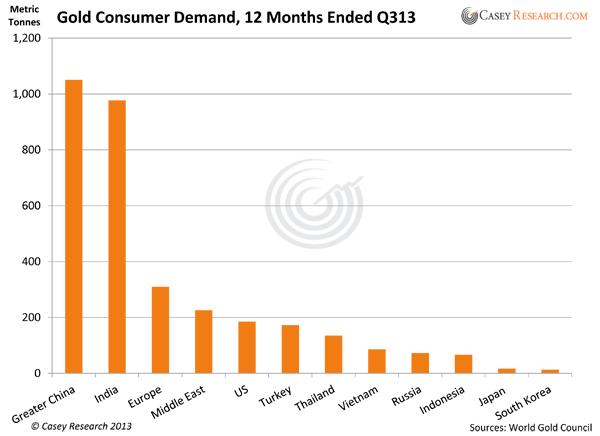
  • China, of course, is the 800-pound gorilla that mainstream analysts seem determined to ignore. Though nothing official has been announced by China's central bank, the chart below provides some perspective into the country's consumer buying habits.
China ended 2013 officially as the largest gold consumer in the world. Chinese sentiment towards gold is well echoed in a statement made by Liu Zhongbo of the Agricultural Bank of China: "Because gold has capabilities to absorb external economic shocks, growth of its use in the international monetary system will be imminent."
And those commercial banks that have been verbally slamming gold—it turns out many are not as negative as it might seem…
  • Goldman Sachs proved itself to be one of the biggest hypocrites: while advising clients to sell gold and buy Treasuries in Q2 2013, it bought a stunning (and record) 3.7 million shares of GLD. And when Venezuela decided to raise cash by pawning its gold, guess who jumped in to handle the transaction? Yes, they claim the price will fall this year, but with such a slippery track record, it's important to watch what they do and not what they say.
  • Société Générale Strategist Albert Edwards says gold will top $10,000 per ounce (with the S&P 500 Index tumbling to 450 and Treasuries yielding less than 1%).
  • JPMorgan Chase went on record in August recommending clients "position for a short-term bounce in gold." Gold's price resistance to Paulson & Co. cutting its gold exposure, along with growing physical gold demand in Asia, were cited among the main reasons.
  • ScotiaMocatta's Sunil Kashyap said that despite the selloff, there's still significant physical demand for gold, especially from India and China, which "supports prices."
  • Commerzbank calls for the gold price to enter a boom period this year. Based on investment demand from Asian countries—China and India in particular—the bank predicted the yellow metal will rise to $1,400 by the end of 2014.
  • Bank of America Merrill Lynch, in spite of lower price forecasts for gold this year, reiterated they remain "longer-term bulls."
  • Citibank's top technical analyst Tom Fitzpatrick stated gold could head to $3,500. "We believe we are back into that track where gold is the hard currency of choice, and we expect for this trend to accelerate going forward."
None of these parties thinks the gold bull market is over. What they care about is safety in this uncertain environment, as well as what they see as enormous potential upside.
In the end, the much ridiculed goldbugs will have had the last laugh.
We can speculate about when the next uptrend in gold will set in, but the action for today is to take advantage of price weakness. Learn about the best gold producers to invest in—now at bargain-basement prices. Try BIG GOLD for 3 months, risk-free, with 100% money-back guarantee. Click here to get started."


Enhanced by Zemanta