Showing posts with label DOW. Show all posts

Monday, March 24, 2014

Carl Icahn And DOW Chart: Houston We Have A Problem - Major Sell Down Coming DIA SPY QQQ


  Carl Icahn knows how to move Apple share price with couple of tweets, is he now engaging with the FED and will demand to Taper The Taper? His Call today about the Major Sell Down Of Market Coming is very well timed. On the daily chart above you can see very ugly Bearish Candle printed last Friday. We have very well defined Double Top Bearish Reversal in place. 


  Weekly chart is not much better as well. If the Dow on daily chart will break down we can have the Double Top formation confirmed. Please notice that Volume has not confirmed the Second High and all momentum indicators are going Down as well. Will Carl Icahn help the market to break down now or will he "negotiate" with the FED to Taper The Taper in exchange for his more optimistic tweets?
  Today's Sell off in Gold can not masquerade the Golden Cross which we have discussed on Friday and US dollar is smelling something coming diving below 80.00 to 79.80 again.

Gold Has Completed The Golden Cross, Major Bullish Reversal Is Underway MUX TNR.v GLD GDX

 "Gold has completed The Golden Cross and major Bullish Reversal is underway after this "FOMC week" correction. Now we should move much higher and Goldman Sachs with its call for Gold $1,050 by the end of the year is the very good contrarian indicator."

ZeroHedge:

Carl Icahn's Next No-Brainer? "A Major Sell-Down Of Artificial Market Is Coming"


"Sprinkled in between Herbalife promotion and eBay board decimation, CNBC's favorite crowd-pleaser Carl Icahn offered a few pearls of wisdom that the TV anchors were un-prepared for:
  • *ICAHN SEES MAJOR SELL DOWN OF MARKET COMING
  • *ICAHN CALLS MARKET ARTIFICIAL BECAUSE OF FED POLICY
Of course, Icahn did not specify the timing which provided just enough cover for the talking heads to confirm their "but stocks are a buy" perspective. We wonder whether the "sell-down" is as big a "no-brainer" as many of Carl's other ideas.
Icahn had plenty to say:


Tuesday, January 28, 2014

Rob McEwen: Will Gold Soar on the Dow Drop? MUX, TNR.v, GDX, GLD, SLV


  Rob McEwen is in demand now about his views on Gold with equity bubble being challenged last few days. Market manipulations can not be run forever and reality will be settling in at some point. This time can be very close now with Durable Goods report out at  - 4.3% (!) in December vs 2.6% in November. Last Jobs Number disaster can be not so "out of range' now as the bubble Media would like us all to think. Gold is at the very important juncture now and decisive move above $1270 will create the short covering fireworks.
  Rob continues to innovate even in the tough markets, has appointed the very young and promising Ian Ball as President and now even launched his own drone at El Galo 1! We hope that now he can see the best strategy for the world class Los Azules Copper deposit to realise its value for McEwen Mining and TNR Gold.

McEwen Mining El Gallo Test Drone


Rob McEwen On Goldcorp's Hostile Bid, M&A Opportunity And Market Bottoms MUX, TNR.v, GLD, GDX


Drilling at Grass Valley, southwest of Barrick's Cortez Mine in Nevada, started this week!

  With general equity markets sliding into the territory which will challenge Bernanke's Happy Exit with Tapering, time is to listen to those who have seen and have done it. Rob McEwen is dissecting the recent market situation in Gold and M&A activity, which will make the best stories in the market to move very fast from the bottom. McEwen Mining has bottomed at $1.65 in December and has closed at $2.63 last Friday. Los Azules Copper project will be the one of the coming M&A stories this year, which will move valuations of McEwen Mining and TNR Gold. TNR Gold holds shares of McEwen Mining after the settlement on Los Azules. Rob McEwen has announced on Twitter about the commencement of drilling in Nevada now. With Gold crossing $1270 and closing just below it we have a very exciting time for the best stories in junior mining these days."

McEwen Mining Receives Final Environmental Permit for Construction and Operation of El Gallo 2 Project MUX, TNR.v, GDX


  "Rob McEwen is on track with development of El Galo 2 and now, after the last main permit has been granted by Mexican authorities, the only question remains where the capital will come from. McEwen Mining had a very impressive run from December $1.65 low to the recent highs of $2.63. Los Azules Copper development remains the major catalyst for McEwen Mining in case of sale of this asset and it will make development of the existing pipeline of project feasible and further acquisitions will bring the dreams about S&P 500 back."

McEwen Mining And TNR Gold: China Lights the Way for Copper MUX, TNR.v, GDX, CU


  "Nobody loves miners any more - it could be the very good time to accumulate the best stories in the market place. And now it looks like that December was a really good time for it. Still under the radar screens of the mainstream investors best junior miners are turning around from historical oversold levels. Last week CITI went bullish on miners for the first time in three years, so the story will be getting out and new money will be coming into the sector now.
  McEwen Mining has been breaking out with the very impressive run from retesting lows of 2013 at just above $1.65 level in mid December to this last Friday close of $2.49 on Volume of 5 million shares. TNR Gold is getting its bids as well now and closed at CAD0.055 last week. Los Azules copper is the key to valuation catalyst for both companies now. TNR Gold holds shares of McEwen Mining after the settlement on Los Azules. TNR Gold is selling its Back-In right with PI Financial engaged and Rob McEwen was relying on Los Azules sale to finance its ambitious expansion plans. 
  In the recent interview Rob has discussed Argentina situation, which is changing for the better now. Nothing is easy in these markets, but any developments with Los Azules will be the game changer for McEwen Mining and TNR Gold. Rob is talking about potential acquisitions for McEwen Mining, ongoing drilling in Nevada in Q1 and his conversation with "person from the ground in China." Not a lot of people are expecting it, but 5 dollar Copper could be in the cards, according to that source. Needless to say that it will make very happy shareholders of McEwen Mining and TNR Gold and Rob is still standing by his $5,000 price for Gold.
  Recent impressive rally in McEwen Mining was fired by the huge short position of over 30 million shares as of December 2013 and should Gold continue its run to the upside  shorts will be very nervous. The WSJ article  is providing some confirmation of the potential change in the trend for Copper as well."


McEwen Mining And TNR Gold: Report - Argentina Is In The Mood For Change On Investment Policy TNR.v, MUX, LCC.v, SSRI, PAA

"Argentina mining landscape is changing for the better according to the report by BN Americas. Lumina Copper is trading above CAD 6.00, McEwen Mining is breaking out to the upside and TNR Gold has found some bids as well recently."


Los Azules Copper - McEwen Mining And TNR Gold: Yamana Gold to invest $450 million in Argentine mine MUX, TNR.v, LCC.v


  "It looks like the shift in Argentina for the better is happening for real this time. Rob McEwen has discussed it in his recent presentation and that in his opinion "we have seen the low in Argentina after  a lot of disappointment". Shevron special Shale Oil deal, repayment to Repsol and now Yamana Gold investment are certainly the things we would like to see now after elections. Lumina copper is holding above CAD5.00 these days and McEwen Mining and TNR Gold should benefit from Los Azules copper revised valuation now."


Huffington Post:
Will Gold Soar on the Dow Drop?


2014-01-27-rob_on_gold_600.jpg
Photo: Rob McEwen, executive chairman and chief owner, McEwen Mining
What's bad for the Dow is great for gold. Last week, the Dow Jones Industrial Average dropped over 600 points, sparking a Gold Bug swoon. Gold prices polished up two percent, while McEwen Mining, a junior gold mining company, popped 10 percent.
Rob McEwen, the executive chairman and chief owner of McEwen Mining has been in the gold mining business for 25 years. Under his leadership, Goldcorp grew from a market capitalization of $50 million to over $8 billion. So, I turned to him for wisdom and experience on today's dance between the Dow and gold.
Natalie Pace: What happened to gold in 2013? Has gold hit a low? Where will prices go in 2014? What's in your crystal ball?
Rob McEwen: Gold certainly fell out of favor in late 2012 and all of 2013; however, the reason for owning gold hasn't gone away. There are still large levels of debt and currency issues.
NP: What happened? Who was doing all of that selling? From the stats I saw, it was almost exclusively exchange-traded funds.
RM: There was a great deal of selling in the paper market, in the derivatives. You saw strange occurrences where the value of gold in the exchange-traded funds was dropping very quickly, while the physical market was trading at a premium. There was very big buying happening in Asia -- principally in India for awhile, and in Hong Kong for the Chinese market. They've remained large buyers of gold.
NP: Where are gold prices headed?
I think gold this year has a chance to test the highs that it achieved back in 2011, which would be just above $1900 an ounce. Beyond that, I believe that we are going to see a $5000/ounce gold price in the next couple of years. For someone who is a contrary investor, it's a good time to be looking at gold. I think gold stocks more so because they've been so beaten up in this market.
NP: You have a very ambitious goal of getting a listing on the S&P 500 by 2015. Are you still on track for that? What do you need to get there?
RM: We might be a little delayed to get there by the end of 2015. In order to qualify for the S&P 500, you need to have a $5 billion plus market capitalization. Our market capitalization is a little more than a tenth of that right now. We need more production. I'd prefer to see it organically. But that's not possible in the next two years to get that type of growth.
NP: Why do you have such a strong focus on getting the S&P 500 listing?
RM: The attraction of the S&P 500 is that there is only one gold stock there and that is Newmont Mining. There are over a trillion dollars invested by index funds in the S&P 500. So, you have a large pool of capital. You have long-term investors, and you have a lower cost of capital when you are in that index, which allows you to grow faster and cheaper than your competition. And the only way to get into the S&P 500 is by being an American company. Most of the mining companies, particularly in the precious metals space, are Canadian, Australian, or non-American. There wouldn't be more than a handful of companies that would have a shot at getting into that space. It's a competitive advantage we have.
NP: You focus on exploration, in addition to production. Please tell us how exploration helped you build shareholder value at your previous company, Goldcorp.
RM: It worked very well. We found more than six million ounces of gold in a mine and made the mine a very profitable enterprise. We launched our [Goldcorp] contest back in 2000. We spent about a million dollars -- half a million in prizes and half a million setting it up. And we found three billion dollars worth of gold.
NP: How are you identifying your exploration targets today?
Right now, we're exploring in Nevada, joint ventured with a company [that] measures the quantity of gold in the water in parts per trillion. When you get an elevated level of gold, that's not a bad target to be drilling on. So, we're going to be drilling this first quarter on a target there and a couple of targets around our property. What makes it interesting is that 10 miles away is the largest gold mine in the world that is run by Barrick Gold.
NP: You've been hoping to capitalize on your Nevada land since the inception of U.S. Gold? How have previous exploration attempts gone, and what is different this time?
RM: We were looking for deeper targets. We didn't find anything on our Tonkin Property. But at the south end of that property, we're reactivating a mine with a permit that we're hoping to get by the first quarter of 2015. It's a low capital build, low cost, eight-year life operation.
[Exploration] drove Goldcorp's success in the early days. The value you create can be very dramatic when you hit.
NP: Exploration costs money. How is McEwen Mining positioned in terms of capital? Will you need to raise money in the debt markets? Are you going to have to pull out your wallet again?
RM: In terms of this year, our expansion of our one gold mine in Mexico, that's taken care of. We're about $30 million in cash right now. We don't have any debt. We have talked to some lenders about putting a small amount of leverage on the balance sheet, but I'm not a big believer in levering up the balance sheet very much. With regard to our large Mexican property, right now, given the price of gold and the lack of enthusiasm in the market, I'm not anxious to run out and do a financing.
NP: How is the cash flow? Are you starting to generate some free cash, are you breaking even, or are you in cash burn?
RM: Our all-in costs are around $1100/ounce. This year, if metal prices stay where they are, we would maintain our cash, which is about $30 million. To build our next big project, we'd have to go find a source of capital, either debt or debt and equity, or through a combination of another company that has free cash. We will in 2016 or 2017 have considerable cash flow on our models. It should be a very positive situation.
NP: We saw some very dramatic price swings in the McEwen Mining share price in 2013. Will that continue to be the case? Or is this the beginning of better days to come?
RM: Our production is moving from 140,000 thousand ounces of gold this year -- up 33 percent from last year. This year will be flat. Then 2015 will be 175,000. With the new mine in Nevada, we'll be above 225,000. With the new mine in Mexico, we'll need some money to build that one, but we'd be over 300,000 ounces a year in gold and silver. So, I'm quite excited about that.
NP: And that doesn't include your copper reserves in Argentina, or anything that you might discover in your exploration.
RM: There will be discoveries that seem to come out of the blue. They are going to happen by smaller companies that have been working away and are ignored by the market.
NP: Last week, the contrarian dance between the Dow and gold was as dynamic as ever - perhaps surprising investors who had given up on gold.
You can have some very dramatic moves. In August of last year, we saw the gold market look like it was coming alive for a moment. In juniors and mid-sizes, and even the seniors, we saw movements of 25 percent to 75 percent gains within the month of August. They gave up those gains in September, but what it illustrated for me was that when people start moving back into gold, it's not going to be a slow run-up. There are going to be some very explosive jumps in value that are going to surprise most people because they have ignored the sector. From the lows of July last year, we got down to about $1.60 and we're now trading at [$2.60]. It may seem like a big move, but it's still a distance from the highs that were achieved when gold went up to $1900. So, I think you're going to see some very strong runs in gold stock."


Please Note our Legal Disclaimer on the Blog, including, but Not limited to:

There are NO Qualified Persons among the authors of this blog as it is defined by NI 43-101, we were NOT able to verify and check any provided information in the articles, news releases or on the links embedded on this blog; you must NOT rely in any sense on any of this information in order to make any resource or value calculation, or attribute any particular value or Price Target to any discussed securities.

We Do Not own any content in the third parties' articles, news releases, videos or on the links embedded on this blog; any opinions - including, but not limited to the resource estimations, valuations, target prices and particular recommendations on any securities expressed there - are subject to the disclosure provided by those third parties and are NOT verified, approved or endorsed by the authors of this blog in any way.

Please, do not forget, that we own stocks we are writing about and have position in these companies. We are not providing any investment advice on this blog and there is no solicitation to buy or sell any particular company.

Enhanced by Zemanta

Tuesday, September 10, 2013

Vampire Squid Overtakes America: Goldman Sachs Is In The Dow - Target Revised to 36,000.


The Great American Bubble Machine


  Front-running everybody has been never rewarded better on the Planet Ponzi and Dow is now primed again for 36,000. Just take out of the Dow all manufacturing and increase the debt ceiling to 22 trillion and if there are still enough Muppets to be ripped off - it is the done deal.


Guess Which "Bearish" Bank Bought A Record Amount Of GLD In Q2 GLD, GDX, GDXJ, MUX, TNR.v

"Zero Hedge reports what we have already suspected, but now it is the matter of fact and we have the clear answer Who Was Buying. We must be close to that Waking Up Moment Peter Schiff is talking about."

How Goldman Sachs Has Made 5 Billion Dollars By Rigging Aluminum Market.

"Competition to JPMorgan in commodities market manipulations is heating up."

Jim Rogers on George Soros, Goldman Sachs and When Harvard and Stanford Will Go Bust.

"As you know, we are not in a position to give any investment advice, we never tell you what to buy and what to sell. We are in the education business and only share with you our travel diary. Today we would like to share another idea about one of your best investment in yourself you can allow: buy and read this book from Jim Rogers.
  If you would like to know about The Break Up with George Soros on his "manipulations of the markets", why Jim O'Neill and Steven Roach "do not have a clue" about Emerging Markets (as the rest of the Wall Street) and how Allan Greenspan - "mediocre economist" has ruined the United States - this book is for you. What to expect next with the "Yes Man" - Mr Bernanke running the FED for his friends will be coming there as well. Inflation will be presented in a very interesting way by Jim - "How many Congressmen you could buy before for the price of one today."
  Please do not miss among the headline revelations, the real wisdom about this world and investing. You must know what you are doing and be the best in it, just one thing at a time. It will be enough. We will add: "Trust your Swing" - particularly when it is tough. 


  We guess that now, after Tim Geithner has joined CFR with his Turbo Tax skills you do not need to immigrate to Singapore to speak up your mind. The Masters and their Puppets are in a plain view, running the show for the Muppets without any constrains by secrecy any more."


Enhanced by Zemanta

Saturday, August 24, 2013

Adam Hamilton: Stock Bear Looms


  Adam Hamilton provides another clue for our quest for catalyst for the Gold market. We are not shorting the markets in times of QE up to infinity, but rather looking for the new Bulls propelled by monetary suicides.
  Coupled with multiple occurrences of Hindenburg Omen and recent call from Charles Nenner this bearish call should be treated with outmost respect. 
  We have shared here before the correlations between falling equity markets and Gold price presented by Adam Hamilton.

Adam Hamilton: Gold and GLD Exodus Reversal MUX, TNR.v

"Adam Hamilton provides now a very compelling case for the General Equity Markets and GLD relationships and correlations and if you do not think that trees can grow straight up to the sky we are at the historical point in the markets development in the age of FED central planning now."

Charles Nenner to Moneynews: US Headed for Recession and It's 'Going to Be Bad'


"Charles Nenner talks about the potential of another recession in the U.S. and his Call must be taken seriously. Surging rates these days even before the beginning of the Tapering will put enormous pressure on the consumers and coupled with high gas prices his prediction can become true again."


ZEAL:

Adam Hamilton     August 23, 2013     3001 Words

The US stock markets have enjoyed a dazzling year, levitating to a long series of new record highs.  But this relentless advance has stalled in August, with selling pressure mounting.  Even most of the bulls readily agree that a material selloff is overdue after such a mighty run.  But actually the odds are high this necessary retreat will extend well beyond normal pullbacks or even corrections into a new cyclical bear.

The mere idea of a looming stock bear is certainly heretical these days, but this is not surprising.  By early August, the flagship S&P 500 stock index (SPX) had powered an astounding 152.7% higher since March 2009!  Being so deep into such a spectacular cyclical bull has naturally left speculators and investors very complacent.  Most have forgotten that markets don’t move in one direction forever, they flow and ebb.

Still, late in mature cyclical bulls the ever-rising chances for the birth of a new cyclical bear are the last thing traders want to hear.  So let’s shelve that controversial thesis for now and start at common ground.  Nearly every smart bull either expects a material stock-market selloff or thinks one would be very healthy.  And technical and sentimental indicators are nearly unanimous in declaring the SPX very overbought.

Discussing all of these would require a sizable tome, but here’s an overview.  The SPX is stretched far aboveits trailing 200-day moving average.  Complacency is extremely high and fear non-existent as measured by key sentiment gauges.  2013’s SPX levitation has been on low and dwindling volume and narrowing market breadth, with fewer and fewer individual stocks maintaining the rally’s momentum.

Students of the markets can elaborate on these major topping indicators in depth, and expound on dozens more.  So the bears and smart bulls alike definitely agree that some kind of material selloff in the US stock markets is either already underway or imminent.  The only real questions are about its ultimate magnitude and duration.  The difference between a down day and a bear market is simply one of degree.

This is reflected in how material stock-market selloffs are categorized.  Anything under 4% is merely a series of down days without any formal name.  When selloffs extend from 4% to 10% off their preceding highs, they are called pullbacks.  Once they forge over 10%, they become known as corrections.  And if the selling continues long enough to push them over 20%, these selloffs become cyclical bear markets.

Pullbacks are fairly common in cyclical bull markets, usually on the order of 3 or 4 per year.  Corrections are considerably rarer, only happening about once a year on average.  Both types of selloffs are critical for keeping bull markets healthy.  They act to rebalance sentiment, bleeding off greed before it grows excessive enough to threaten the bull market’s very existence.  Selloffs are an essential safety valve.

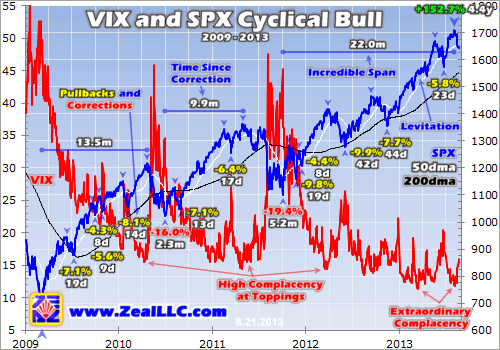
One of the primary reasons a material selloff is so overdue today is the remarkable lack of them since mid-November 2012 when this year’s relentless levitation was born.  During the 9 months since, there has only been one pullback and zero corrections.  As this first chart shows, this is very anomalous.  The longer a bull market goes without a material selloff to rebalance sentiment, the more precarious it gets.

Even by the precedent of today’s cyclical bull, the recent lack of material selloffs is striking.  The SPX is rendered in blue below, with every pullback and correction of its entire bull run noted in yellow and red respectively.  Especially the past year or so is really conspicuous for the absence of these healthy and essential events.  The benchmark VIX fear gauge is also shown in red, warning of extreme complacency.


In the 8.5 months between mid-November 2012 and early August 2013 where the SPX soared 26.3% higher, there’s only been one material selloff.  And at 5.8%, it was merely a smallish pullback running between late May and late June.  There were minor series of down days amounting to 3.1% in late December, 2.8% in late February, and 3.2% in mid-April, but they didn’t even approach pullback magnitude.

As of the middle of this week, August’s nascent SPX selloff had grown to 3.9%.  But all these selling events were very minor.  The smaller the selloff, the less greed it bleeds off and thus the more sentiment remains out of balance.  Prior to 2013, the average pullback in the SPX’s entire mighty cyclical bull was over 7.0%.  So the lone 5.8% in the past 9 months’ incredible levitation is far from sufficient to rebalance.

And that explains the rampant euphoria plaguing the stock markets this year.  The financial media has been bursting at the seams with analysts and traders touting stocks as the only place to be.  Many have been arguing a correction-magnitude selloff is all but impossible!  Talk about hubris.  The longer any bull market goes without big-enough selloffs to deflate greed, the more this dangerous emotion flourishes.

Thus long stock-market levitations without material selloffs inevitably lead to full-blown corrections.  The last example occurred back in mid-2011, when the SPX corrected sharply.  Much like today, it had spent 9.9 months levitating with only two mild pullbacks.  So when the selling finally arrived, it was big.  So much complacency and greed had built up that it took a serious 19.4% selloff to fully eradicate that imbalance.

The parallels between that last SPX levitation and today’s are ominous.  Measured by that flagship index, the stock markets had climbed 33.3% in 9.9 months.  Today we are at 26.3% in 8.5 months.  The second pullback of that earlier levitation occurred late in it, and was relatively mild.  A slightly-higher secondary top was seen soon after as the perma-bulls foolishly refused to heed the dangers of overbought markets.

Sound familiar?  The technical pattern we’ve seen in recent months matches the early-2011 topping pattern remarkably well.  A long SPX levitation sans-pullbacks generated extraordinary complacency and greed, and the initial mild pullback was ignored by the bulls.  Their topping-indicators-be-damned buy-the-dips mentality was able to bully the SPX up to a secondary high on low volume, but it soon failed too.

And thus a correction arrived then and is certainly overdue now.  On average a correction-magnitude selloff happens about once a year in a healthy cyclical bull market.  As of early August’s recent high, the SPX had gone a breathtaking 22.0 months without a correction!  That just boggles the mind.  This bull’s previous spans between corrections were merely 13.5m and 9.9m.  Never has one been more overdue.

Corrections are easy to comprehend in the abstract, but are scary events to weather.  They force stock prices down so close to bear-market territory that most of the greedy traders who were hyper-bullish at the preceding top totally capitulate.  Back in both mid-2010 and late 2011 just after this cyclical bull’s previous corrections, I wrote hardcore contrarian essays that were very bullish when everyone else was terrified.

Corrections drag the great sentiment pendulum from extreme greed and complacency at the preceding top to extreme fear and despair at that selloff’s nadir.  A merely average correction is 15%.  Measured off the SPX’s latest early-August peak, that would hammer the SPX back down to 1453.  That’s not only 11.5% lower than this week’s levels, but would erase the SPX’s gains for this entire calendar year!

But it’s been so darned long since this cyclical bull has seen a necessary and healthy correction that I can’t imagine it will be small or average.  Complacency is always high at major toppings, as measured by the low VIX.  Since this implied-volatility index effectively measures prevailing fear, a low reading shows the absence of it which is complacency.  Recent months’ VIX lows have revealed extraordinary complacency.

So even if this cyclical bull is alive and well and has years left to run as Wall Street analysts have boldly asserted all year long, a big correction is overdue and inevitable.  The last correction was 19.4% in mid-2011, which is about as big as they can get.  A similar event today off the recent highs would crush the SPX down to 1378, another 16.1% below this week’s levels.  Just imagine the havoc that would wreak!

Round that big-correction target to 1375.  This mighty cyclical bull first challenged 1375 in April 2011, and first achieved it a year later in March 2012.  So at the nadir of the next correction, somewhere between 1.4 and 2.3 years of this entire 4.4-year-long cyclical bull’s gains will have vanished!  Both investors and speculators alike will have had their wills broken by that point, being extremely pessimistic and bearish.

Remember that the difference between a down day and a cyclical bear market is merely one of degree.  There is simply no arguing that the US stock markets are way overdue for a major correction.  And once that comes to pass, and the SPX is 17%, 18%, 19% off its recent peak, it won’t take much additional selling to push it over that 20% threshold.  One big down day would do it.  That would make a new bear.

Now calling for a new cyclical bear market in stocks is not something that can be done lightly.  Material selloffs that ultimately grow big enough to exceed 20% only happen in very specific conditions.  I didn’t even start thinking about one until a year ago.  Back in mid-2011 halfway through the last major correction, I evenactively argued against a new cyclical bear.  Cyclical bears are only born when cyclical bulls mature.

The really ominous thing today is our current cyclical bull is long past mature.  It has lasted much longer and risen much farther than average, which is the real reason a new stock bear looms.  While Wall Street and the vast majority of investors are loath to admit it, we remain mired deep within a secular bear.  These are simply very long consolidations, where the stock markets grind sideways for a whopping 17 years.

Stock markets move in great third-of-a-century cycles I call Long Valuation Waves.  The first half of each single wave is a secular stock bull, and the second half a secular stock bear.  The entire reason the bear half exists for those 17 long years is to allow stock-market valuations to mean revert from excessive highs at the ends of the preceding bull.  Like all major market reversions, they overshoot before the bear ends.

These secular bears force stock markets to grind sideways on balance, giving underlying corporate earnings time to catch up with high stock prices.  Mechanically this happens through a series of shorter cyclical bears and cyclical bulls within the secular-bear span.  It is nearly impossible to be a successful investor if you don’t understand these secular and cyclical cycles and their impact on stock prices.

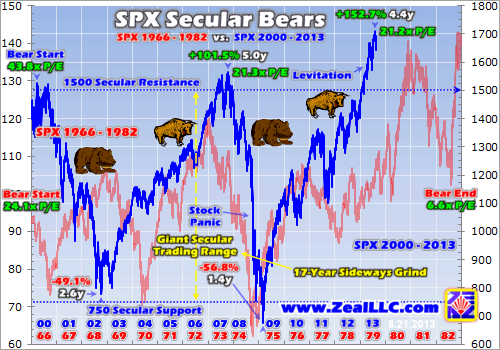
This next chart shows our current SPX secular bear superimposed over the last one between 1966 and 1982.  This perspective is invaluable yet hard to find, the financial media almost never talks about it.  Wall Street perpetually tries to convince investors that anytime is a great time to buy stocks.  But the investors who foolishly buy general stocks high near the ends of mid-secular-bear cyclical bulls get slaughtered.


The past 13 years’ secular bear dominates the long-term SPX charts, it is undeniable.  Stocks have simply ground sideways at best since the last secular bull topped in March 2000.  While the financial media has been elatedly celebrating new record highs this year, at best the SPX was only up 11.9% over the 13.4 yearsbetween March 2000 and August 2013.  This compounds to about a 0.85% annual return.

Earning capital gains in the general stock markets of less than 1% per year at best for over 13 years is horrendously bad.  Factor in inflation, and there were actually big real losses.  Dividends helped offset some of these, but overall the long-term investors who stayed invested throughout this secular bear have still suffered substantial losses at best.  Secular bear markets are brutally unforgiving, eviscerating the naive.

Their sideways grinds are a series of cyclical bears and bulls.  The cyclical bears generally cut stock prices in half, and then the subsequent cyclical bulls generally double them again back up to their starting point.  So while secular bears slaughter buy-and-hold investors, they are very profitable to trade.  The key is buying stocks when they near secular support, then selling later when they hit secular resistance.

Secular support and secular resistance on the SPX are around 750 and 1500 respectively.  Support is hit after mid-secular-bear cyclical bears, and resistance is hit after mid-secular-bear cyclical bulls.  Like any technical lines, these are zones and not hard limits.  The SPX can overshoot in both directions, but not for long.  Soon the dominating secular trading range reasserts itself and sucks the SPX back into its maw.

In late January 2013, the SPX broke above this 1500 secular resistance.  In late March, it edged up to new all-time nominal highs (though it had and still remains far from real ones).  The last mighty cyclical bull topping in October 2007 overshot as well, but soon succumbed to the unyielding secular bear.  So not even 1700 on the SPX gets us out of the woods until the bear’s mission has been accomplished.

And that is to force the stock markets to trade sideways for long enough for valuations to plunge from extremely overvalued to extremely undervalued levels.  In P/E-ratio terms, secular bears are born at general-market valuations above 28x earnings (twice the 14x long-term fair value) and end around 7x earnings (half fair value).  Today’s secular bear won’t end until the SPX hits 7x earnings once again.

When it was born way back in early 2000, the SPX traded in a spectacular bubble at 43.8x.  7.6 years later in October 2007 when the last cyclical bull topped, its P/E ratio had fallen to 21.3x.  While the SPX was at the same levels, corporate earnings had grown enough to cut valuations in half.  But stocks were still very expensive.  Even during those epic stock-panic lows in early 2009, the SPX only fell to 11.6x at worst.

That was 9.0 years into this secular bear, and the best chance the stock markets had to hit those 7x secular-bear-ending levels.  They failed, virtually assuring this valuation-driven secular bear would continue for its entire 17-year normal duration.  Today 13.4 years into that span, the SPX is once again at the same hightopping valuation of 21.2x seen in late 2007.  Its work far from done, this secular bear is far from over.

Greatly amplifying the danger today, the SPX is not only far above its secular-bear resistance of 1500 but the current cyclical bull has powered far too high for far too long.  It is up an astounding 152.7% over 4.4 years (or 53 months)!  Meanwhile the average size and duration of modern mid-secular-bear cyclical bulls is only a doubling over 35 months.  The more excessive the extreme, the bigger and faster the mean reversion.

The secular bear that has been plaguing the stock markets since early 2000 hasn’t even come close yet to accomplishing its mission.  Today’s stock-market valuations are three times higher than the 7x target, and even at their lowest point in early 2009 were still 2/3rds higher.  And this secular bear still remains several years away from hitting their tight average duration of 17 years.  It hasn’t had sufficient time to mature yet.

So as you can see, the US stock markets are in an extraordinarily dangerous place today.  They are very overdue for a selloff, and that almost certainly has to grow into a major correction to rebalance sentiment.  And one or two sizable down days late in a major correction when sentiment is dismal is all it takes to push the SPX over that 20% threshold into cyclical-bear territory.  These ultimately cut stock prices in half!

With today’s stock markets euphoric and overbought, with the recent years’ cyclical bull way too old and too high, investors and speculators alike have to be exceedingly careful in the months to come.  Wall Street will deny the coming selloff is meaningful every step of the way down, lulling traders into false security until it is way too late.  You need proven battle-hardened contrarians to help you navigate this transition.

That’s us at Zeal.  We’ve spent decades intensely studying and trading the markets.  We buy low when others are afraid and then later sell high when others are brave.  Fighting the crowd has proven wildly successful.  As of the end of June, we’ve recommended and realized 655 stock trades to our newsletter subscribers since 2001.  They averaged stellar annualized realized gains of +28.6% during a secular bear!

We publish acclaimed weekly and monthly newsletters for speculators and investors.  In them I draw on our decades of hard-won experience, knowledge, wisdom, and ongoing research to explain what is going on in the markets, why, and how to trade them with specific stocks as opportunities arise.  Alternative investmentsincluding gold thrive in cyclical bears.  So if you’ve not been paying attention to the markets, now is the time to get focused again.  Big changes are afoot.  Subscribe today!

The bottom line is the US stock markets are overdue for a material selloff after their massive levitation this year.  And this has to snowball into a full-blown correction since it has been so anomalously long since the last one.  Today’s euphoric sentiment will be so ravaged by the time that correction hits the high teens that it won’t be hard for it to edge over 20% into cyclical-bear territory.  That will push the selloff target to 50%ish!

A new stock bear looming is far from a radical idea, it is merely a high-probability mean reversion.  The ongoing secular bear remains too young to give up its ghost, and far from accomplishing it valuation mission.  Valuations remain very expensive, while the SPX’s cyclical bull is extremely overextended in both magnitude and duration terms.  In light of all this, it’s hard to imagine a new stock bear not being born.

Adam Hamilton, CPA     August 23, 2013 "

Enhanced by Zemanta